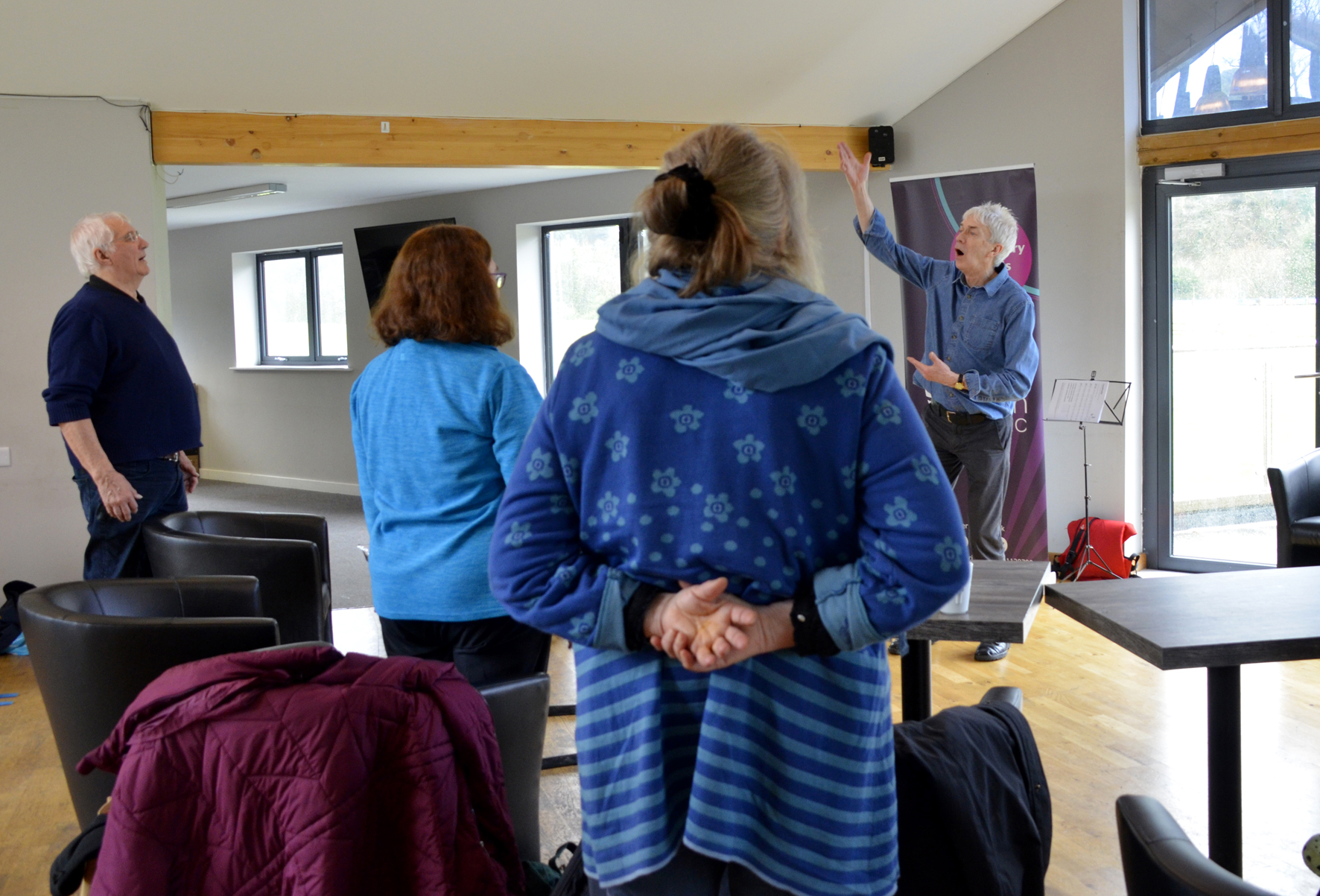
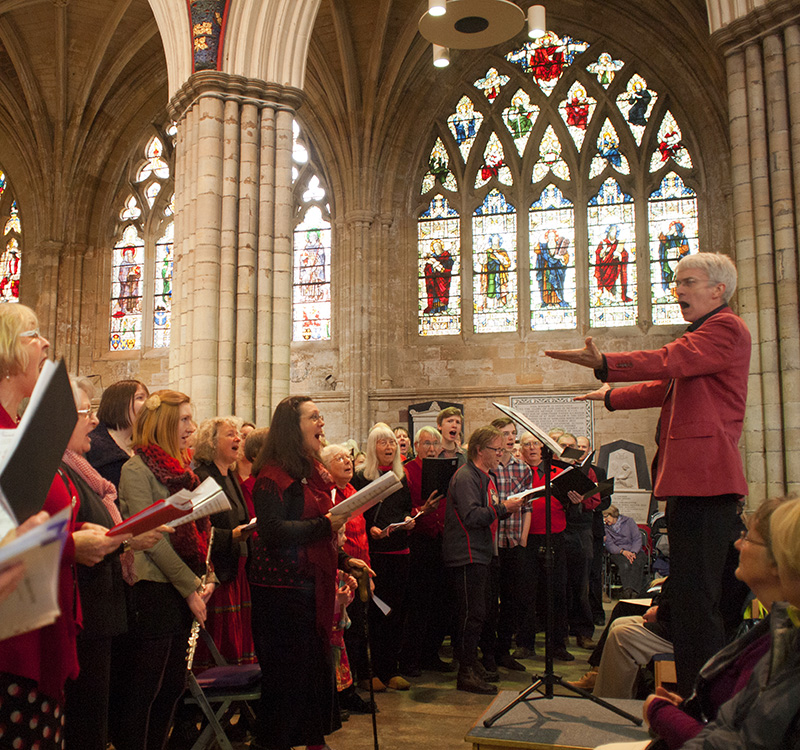


The social health and breathing benefits of our three-year Singing for Wellness project are to be shared at a conference at the University of Plymouth (UoP) this summer, with some of our choir singers saying it’s been “life-changing”.
The project, run in conjunction with the UoP, has reached hundreds of people with respiratory conditions, many of whom felt socially isolated because of their illness.
It was initially launched as an NHS-funded pilot in Torbay. As a result of its success, we received funding from the National Lottery Community Fund to run three Singing for Wellness choirs for a further three years in Okehampton, Honiton and Torbay. This latest project, which runs until the end of the current 2024-25 academic year, has looked particularly at the wider social benefits of singing for people with respiratory conditions, as well as the physical breathing benefits.
At the conference on Friday 11 July, the choirs will be performing songs and talking about how Singing for Wellness has helped them.
The all-day event, which is free to attend, will also see the launch of a Wren Music songbook of well-known songs which can be adapted according to people’s breathing abilities. Each song has with it a ‘song scale of efforts’ which has been devised by the project leaders as a guide to the effort it might take to sing the song. The book will be part of a future ‘tool kit’ for other organisations to use so that more choirs can be set up in the region.
Clinical adviser to the project is Kath Donohue, a respiratory physiotherapist and lecturer at the UoP. She held training days for our professional choir leaders and volunteer teams and has delivered training to health professionals such as GPs, respiratory nurses and Allied Health Professionals as part of the project.
She has also been carrying out research during the three years and her interim findings will be discussed at the conference. It’s hoped that the final research results will lead to it being socially prescribed for respiratory patients in future.
Kath says the social benefits have been even greater than she expected: “I’ve been surprised at the strength of positivity. It’s been quite life-changing for a number of the singers, mostly social, emotional and psychological.
“We’ve seen increasing social connection between adults with respiratory conditions, and an increasing sense of purpose, pride and confidence. Overall, the feedback is that singing together with others gave them opportunities and challenges that they thought they’d lost as they got more poorly. They’ve re-engaged with a social life and have seen a return of abilities which they thought they’d lost forever. Some have told me that they’ve got their laughter and enjoyment back.
“Another benefit that I didn’t expect to see is the increase in confidence of their carers. The support has helped them and reduced their stress.”
She added: “One of the amazing things is the impact the Wren Music choir leaders have had on the singers. Their level of skill and intuition in understanding people’s needs and to adapt their songs and deliver them, has made the singers feel safe to push themselves. That requires a massive trust and shows they’ve felt very safe and supported.”
Kath has helped us to devise the songbook. Each song can be deconstructed and reconstructed, depending on the person’s breathing that day: “The song can be made faster or slowed down according to needs,” she explained. “At one end of the scale, there are more breath pauses, while at the hardest end of the scale, it will be the original version of the song. Anything in between relates to the degree of effort they should feel at that level. So, on a breathless day, people can do the songs using the lower end of the scale. They can also use it to measure how they’re feeling on a given day.”
Kath hopes to take her research findings to publication: “At the end of the year, we’ll be disseminating what we’ve learnt. We’ll have evidence of its impact on both the psychological and emotional well-being of participants. The songbook is groundbreaking. It gives us an evaluation and assessment tool, and it will help future choir leaders who want to run a similar project.”
Already, we’ve had interest in the songbook from other organisations. Printed copies will be available at the conference and can also be ordered online. Jon Dyer, one of our specially trained choir leaders, said: “We’re very excited to share what we’ve learnt from Singing for Wellness, and to launch the songbook. The conference is also an opportunity for people to see how we lead these choir sessions and to hear the choirs sing.”
The choirs each meet once a week, and the singers have fed back that they value this regular contact. Three times a year, the three choirs all get together. We are hoping to secure funding to continue to support the choirs beyond this year: “We’ve built up a strong network to reach different communities and there’s a very strong sense of community with the choirs,” said Jon. “A lot of our singers have said that through coming together and supporting each other, they’re not feeling alone with their illness. We’d like to help keep that support going.”
Read the story about Singing for Wellness, with feedback from some of the singers on our website page.